
My Story - Dr Prabath
By Dr. Prabath, Founder of Millionaire Health Habits & Owner of Unique Medical Cranbourne, Australia
Live Richer in Every Way
By Dr prabath
- The Road To Hell
- Who Am I Now, At Almost Fifty
- Why I Created MH
- What's My Method
- What's My Aim For Myself And My Readers
- Newsletter 1
- Newsletter 2
- Newsletter 3
- Newsletter 4
- Newsletter 5
- Newsletter 6
- Newsletter 7
- Newsletter 8
- Newsletter 9
- Newsletter 10
- Newsletter 11
- Newsletter 12
- Newsletter 13
- Newsletter 14
- Newsletter 15
- Newsletter 16
- Newsletter 17
- Newsletter 18
- Newsletter 19
- Newsletter 20
- Newsletter 21
- Newsletter 22
What Is the Sleep Cycle?
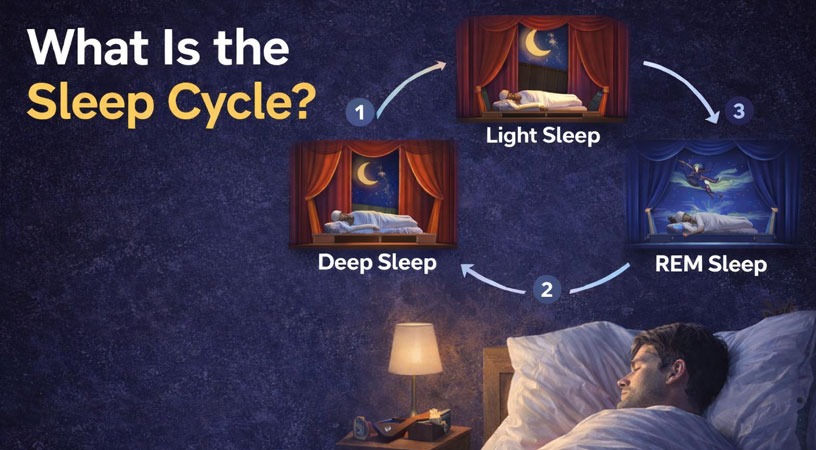
The sleep cycle is the brain’s natural progression through distinct stages of sleep that repeat multiple times during the night. Each cycle lasts approximately 90 minutes (ranging from minutes depending on the individual), and through the night, you typically experience 4 to 6 cycles.Imagine sleep cycles as a stage drama, which replays through the night. It keeps playing and switching over to the next episode, starting from the introduction ( light sleep ), plot developing ( deep sleep ) and the final action sequence ( REM Sleep or dream sleep )
Stages of the Sleep Cycle
The sleep cycle consists primarily of two types of sleep:
1. Non-Rapid Eye Movement (NREM) Sleep
75-80% of total sleep time. Divided into three stages
- N1 (Stage 1)Light sleep, transition from wakefulness to sleep. Brain waves start to slow down (alpha to theta waves). It is easy to be awakened.
- N2 (Stage 2)Deeper light sleep. Characterised by sleep spindles and K-complexes on EEG. Heart rate slows, body temperature drops.
These two stages N1 and N2 are collectively known as light sleep
- N3 (Stage 3)slow-wave sleep (SWS)or deep sleep is dominated by slow delta brain waves. This is the most restorative stage of sleep, associated with physical repair, the release of growth hormone, and immune system strengthening. Hardest stage to awaken from.
2. Rapid Eye Movement (REM) Sleep
20-25% of total sleep time.
Occurs after cycling through the NREM stages.
Characterised by rapid eye movements, brain activity similar to wakefulness (beta waves), vivid dreaming, muscle paralysis (atonia), irregular breathing and heart rate.
Plays a critical role in memory consolidation, emotional regulation, creativity, and brain development.
How Does the Sleep Cycle Progress?
A typical night’s sleep cycle progresses through these stages in a specific order:
- 1. Wakefulness → N1 (Light sleep) → N2 (Light sleep) → N3 (Deep sleep)
The brain descends gradually deeper into restorative sleep.
- 2. After N3, the brain reverses course
It briefly moves back through N2 and then enters REM sleep (a distinct, active brain state).
- 3. The cycle then restarts
After REM ends, the brain moves back toward light sleep (N1 or N2), sometimes briefly awakening, then descends into another NREM phase, followed by REM.
Imagine sleeping to a deep sea dive where you go deeper and deeper and once you are too deep ( NREM N3 sleep) , the diver needs to come back to the surface. So he goes back to light sleep and then REM sleep, which is almost awake and then Changes in Sleep Cycles Across the Night
Early night
The first one or two cycles contain more N3 (deep slow-wave sleep).This phase is crucial for physical restoration, including cell repair, immune system boosts, and clearing toxins from the brain.
Later night
Later cycles have reduced N3 and extended periods of REM sleep.REM dominates toward early morning hours and supports emotional health, memory consolidation (especially of procedural and emotional memories), and learning.
Neurobiological Control of the Sleep Cycle
The sleep cycle is orchestrated by complex interactions among various brain regions and neurochemical systems, including:
Hypothalamus (flip-flop switch)
This controls the overall state of wakefulness vs sleep (Chapter 3’s focus). The VLPO inhibits arousal centres to allow the brain to enter sleep.
Brainstem
Different brainstem nuclei control transitions between NREM and REM stages
NREM-promoting regions quiet down brain activity, allowing delta slow waves to dominate.
REM-promoting nuclei,such as the pedunculopontine and laterodorsal tegmental nuclei, trigger REM by increasing cholinergic (acetylcholine) activity and suppressing other neurotransmitters like norepinephrine and serotonin.
Neurotransmitters
During NREM, GABA promote inhibition and slow-wave activity.
During REM, high levels of acetylcholine activate the cortex, creating brain activity similar to wakefulness, while muscles are paralysed to prevent acting out dreams.
Function of Sleep Cycles
Each sleep cycle stage serves distinct but complementary functions:
> NREM/Slow-Wave Sleep
Physical repair, energy restoration, memory consolidation (mainly declarative memory), and clearing metabolic waste from the brain.
involved in immune system strengthening and metabolic health.
> REM Sleep
Emotional regulation and processing, creativity, and problem-solving.
Different forms of memory consolidation (including procedural and emotional memories) occur.
Brain activity during REM resembles wakefulness, indicating intense brain plasticity.
Influence of Circadian Rhythm and Homeostatic Sleep Pressure
Homeostatic sleep pressure builds up the longer we stay awake, mainly due to adenosine accumulation. It increases the drive to enter NREM sleep, profound sleep.
Circadian rhythm, the hypothalamus’s suprachiasmatic nucleus (SCN) regulates timing, ensuring sleep cycles are aligned. The circadian clock also modulates REM occurrence and timing.
Together, they timetable when sleep happens and influence the depth and duration of each sleep stage and cycle.
In essence
Your brain undergoes multiple cycles of NREM and REM sleep every night
These cycles are active, regulated processes governed by specific brain structures and neurotransmitters.
Each stage serves unique biological functions ,that are essential for physical health, brain function, and emotional well-being.
The architecture of the sleep cycle shifts naturally over the night to optimise these benefits.
So what’s the point of knowing all these fancy stages of sleep? I understand your frustration, so let’s discuss what happens in each stage of sleep to your memory and emotions in the next newsletter

Copyright © 2024 Millionaire Health Habit. All Rights Reserved.
Powered by Creativedot.com.au