
My Story - Dr Prabath
By Dr. Prabath, Founder of Millionaire Health Habits & Owner of Unique Medical Cranbourne, Australia
Live Richer in Every Way
By Dr prabath
- The Road To Hell
- Who Am I Now, At Almost Fifty
- Why I Created MH
- What's My Method
- What's My Aim For Myself And My Readers
- Newsletter 1
- Newsletter 2
- Newsletter 3
- Newsletter 4
- Newsletter 5
- Newsletter 6
- Newsletter 7
- Newsletter 8
- Newsletter 9
- Newsletter 10
- Newsletter 11
- Newsletter 12
- Newsletter 13
- Newsletter 14
- Newsletter 15
- Newsletter 16
- Newsletter 17
- Newsletter 18
- Newsletter 19
- Newsletter 20
- Newsletter 21
- Newsletter 22
Melatonin and Your Body Clock
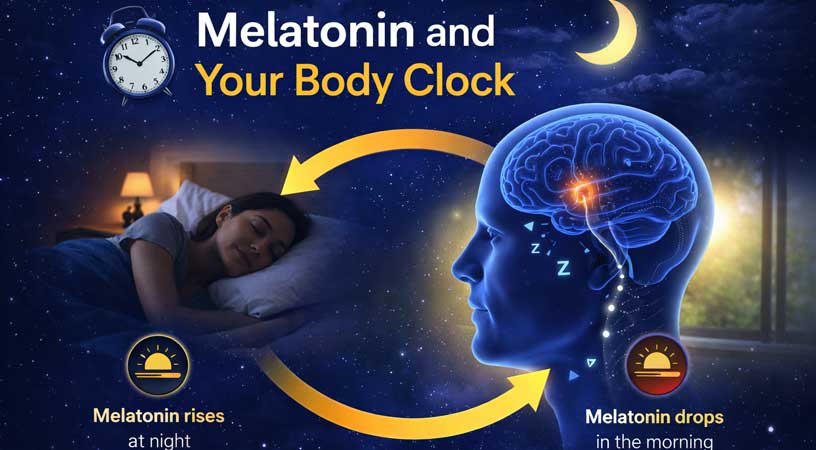
In Chapter 2 of Why We Sleep, Matthew Walker explains melatonin’s critical role in regulating sleep and the human circadian rhythm. This internal biological clock dictates our sleep-wake cycles over about 24 hours.
1. What is Melatonin?
Melatonin is a hormone primarily produced by the pineal gland in the brain. Its secretion is tightly linked to the environment’s light-dark cycle, and it is often called the “hormone of darkness.”
2. How Melatonin Works
As evening approaches and natural light diminishes, the retina in the eyes senses the reduction in light and signals the pineal gland to begin releasing melatonin into the bloodstream. This hormone then acts as a chemical signal to the body that it is time to prepare for sleep.
Melatonin production typically starts a few hours before bedtime (often around 9 pm to 10 pm, depending on the individual’s circadian rhythm), rises throughout the night, and falls sharply in the morning to coordinate sleep timing.
3. Role in Sleep Initiation and Quality
Walker highlights that melatonin is a key signal for the brain’s “biological night,” marking when it is best to sleep for optimal health. Disruptions to melatonin production (for example, from exposure to artificial light or screen devices at night) can delay the onset of sleep and shift the circadian rhythm, contributing to poor or insufficient sleep. So, Melatonin in a way defines the nighttime
4. Melatonin and Light Exposure
I have patients complaining that they lie in bed staring at the phone screen or watching Netflix, hoping to fall asleep! Watching TV or the phone is like taking away the starting judge’s pistol! You are taking away the starting judge’s pistol and delaying the sleep race! And then, because sleep is postponed as the guy is not shooting the gun, you watch more TV, thus injuring the judge. Is there anything more idiotic!
5. Melatonin as a Supplement
Walker touches on the use of melatonin supplements as an aid for sleep problems, such as jet lag or shift work disorder. However, he notes that melatonin supplements are generally mild and more effective for the circadian clock rather than as a sedative. They don’t induce deep or long-lasting sleep but can help signal the body that it’s time to prepare for sleep when natural melatonin rhythms are disrupted. As a physician, I only recommend Melatonin for jet lag and night shift workers. Melatonin should never be a long-term sleep medication
In summary:
Chapter 2 of Why We Sleep portrays melatonin as an essential hormone that signals “nighttime” to the brain and body, driving the biological preparations for restorative sleep. Its production is governed by the light-dark cycle, and protecting its natural rhythm is crucial for overall health and sleep quality.

Copyright © 2024 Millionaire Health Habit. All Rights Reserved.
Powered by Creativedot.com.au